
Working With the Whole Mother–Baby Partnership
One of the principles I am most passionate about and something I regularly teach practitioners, is that when working with babies, we must always treat the whole picture.
When a practitioner works with a baby, it is essential to observe and listen to the mother as well. Understanding how she is feeling, both physically and emotionally, helps us gain a much clearer picture of what is happening for the baby.
If a mother is struggling with her recovery, feeling overwhelmed, or experiencing emotional challenges, this can inevitably influence how her baby settles, feeds, sleeps and develops.
Baby reflexology is very much a collaboration between mother and baby. For reflexology to be most effective, mum needs to feel supported, calm and present while practising techniques with her child.
Starting With a Conversation
Before a mother attends a baby reflexology class, it can be extremely helpful to speak with her beforehand. A short telephone conversation allows you to ask carefully worded, open questions about how both she and her baby are doing.
This initial conversation provides valuable insight into:
How mum is recovering after the birth
How she is coping emotionally
Any challenges baby may be experiencing
What support might be most helpful
With this understanding, you can thoughtfully plan your class to ensure that both baby’s needs and mum’s wellbeing are supported.
Understanding Postnatal Hormones
Hormones have a profound impact on how mothers feel and function in the weeks and months following birth.
During pregnancy and after childbirth, a woman’s body undergoes significant hormonal changes in order to support the needs of her baby. For some women, these fluctuations can continue for several months after birth and may affect their energy, mood and overall wellbeing.
Signs That Hormones May Be Out of Balance
Some common signs may include:
Extreme fatigue
Difficulty losing weight
Mood swings or anxiety
Insomnia
Hair loss
Postnatal depression
Supporting mothers during this time can make an enormous difference to how they cope with the demands of early motherhood.
Supporting the Caregiver
When teaching practitioners, I always recommend including a session that focuses entirely on self-care for the caregiver.
Helping mothers regain a sense of balance and supporting their hormonal wellbeing can significantly improve how they feel, connect and cope during the early stages of motherhood.
Simple tools that can be taught during classes include:
Hand reflexology techniques
Mindfulness practices
Gentle breathing exercises
Even dedicating just five minutes a day for mothers to focus solely on themselves and their baby can have a powerful impact.
Simple Self-Help Hand Reflexology
One of my favourite approaches combines reflexology, breathing and visualisation. Together, these techniques can create a deeply calming and grounding experience.
Teaching this technique gives mothers a simple tool they can keep in their personal self-care toolkit and use whenever they need a moment of calm.
Technique
Begin by gently stroking down the side of the thumb.
As you stroke downward, take a slow deep breath in and count to three.
Stroke back up the thumb while breathing out slowly for five seconds or longer.
Repeat this movement three times.
Next:
Place one finger on the side of the thumb (pineal reflex).
Place another finger near the heel of the hand (spinal reflex / L5 area).
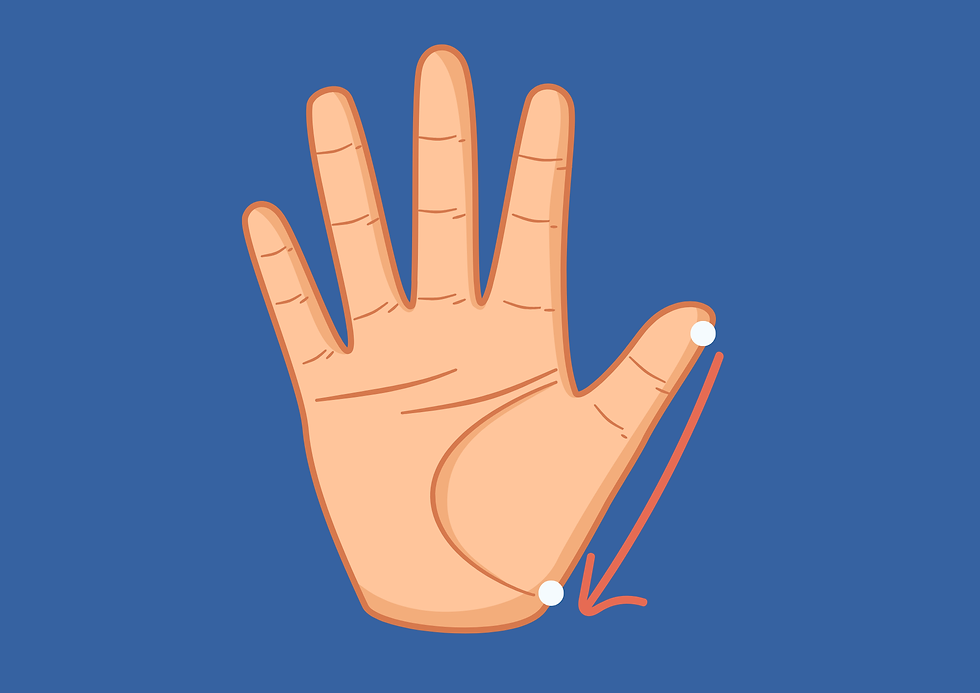
Ask the mother to continue breathing slowly through her nose. Encourage her to close her eyes and imagine a calming scene, perhaps standing beside a peaceful ocean, feeling the warmth of the sun on her face while a gentle breeze moves across the water.
Visualisations can be personalised. You might ask mothers to think of a moment when they felt completely calm and relaxed.
The combination of touch, breath and imagery can create a powerful calming effect, helping to rebalance the mind and body.
Why Breathing Matters
Slow, controlled breathing can help regulate both mood and hormones.
When we breathe slowly and deeply, it stimulates the hypothalamus, an important area of the brain that helps regulate hormone production. The hypothalamus communicates with the pituitary gland, which releases neurohormones that help reduce stress hormones and activate the body's natural relaxation response. The hypothalamus is responsible for maintaining homeostasis — the body's internal balance.
Benefits of Deep Breathing
Deep breathing may help to:
Improve calmness
Support pain relief
Assist detoxification
Strengthen the immune system
Increase energy levels
Improve digestion
A Simple Breathing Technique: Square Breathing
One breathing technique I particularly love teaching mothers is square breathing.
This method combines breath and gentle touch, making it ideal for calming an overwhelmed or overstimulated nervous system.
It is also a wonderful way to begin a reflexology class or one-to-one session, helping mothers to centre themselves before focusing on their baby.
How to Practise Square Breathing
A helpful way to guide the breath is to trace a square shape gently on the palm of the hand, following each side of the square as the breathing sequence progresses.
Inhale slowly for 4 seconds
Hold the breath for 4 seconds
Exhale slowly for 4 seconds
Repeat the cycle

The Role of Mindfulness
Research increasingly shows that mindfulness techniques may support maternal psychological wellbeing.
One study found that mindfulness practices may contribute positively to a mother’s mental health and resilience.
Study reference:https://pubmed.ncbi.nlm.nih.gov/28173769/
At the end of my baby reflexology classes, I love to finish with a guided body scan.
This is a beautiful way for both mother and baby to relax together and deepen their connection.
Guided Body Scan for Mothers
Invite mum to lie comfortably on the floor, bed, or a soft mat, with her baby resting safely close beside her. Encourage her to settle into a position where she feels supported and at ease.
Begin by gently bringing her awareness to the sounds around the room. Perhaps there is the soft breathing of her baby, distant household sounds, or the quiet hum of the world outside. Acknowledge these sounds without judgement. By noticing them now, they are less likely to become distractions later.
She may choose to close her eyes, or softly rest her gaze on her baby.
Allow her to take a slow, steady breath in through the nose… and gently release it through the mouth.
Beginning the Body Scan
Encourage slow, relaxed breathing through the nose.
Invite her to notice the weight of her body resting beneath her. Feel the gentle support of the floor or mattress holding her completely. There is nothing she needs to do right now, nowhere she needs to go.
If any areas feel tight, tired, or heavy, simply acknowledge them with kindness.
Now slowly begin to guide her awareness through the body.
Toes
Bring attention to the toes.
Gently curl the toes, holding for a moment… then slowly release them. Feel the small muscles soften and relax.
Feet
Allow the feet to become heavy and warm.
Imagine the soles of the feet melting gently into the surface beneath them.
Ankles
Slowly rotate the ankles in small circles if it feels comfortable.
Notice any tension softening as the movement releases tightness around the joints.
Lower Legs
Bring awareness to the calves.
Gently tighten the calf muscles, hold for a moment… then release completely.
Feel the lower legs soften and relax.
Knees
Bring your attention to the knees.
Imagine warm water being poured slowly over them, washing away any tightness or strain.
Allow the warmth to soothe and soften the joints.
Upper Legs
Let your awareness travel up through the thighs.
Allow the legs to feel heavy, supported, and grounded.
Release any effort you may be holding here.
Hips and Pelvis
Bring gentle awareness to the hips and pelvis.
If it feels comfortable, gently squeeze the muscles and release.
Allow this important area of the body to soften, rest, and be supported.
Torso
Take a slow, deep breath in through the nose.
Feel the chest and abdomen expand as the lungs fill with air.
Then slowly release the breath, allowing the belly to soften.
Continue breathing slowly and naturally.
Back
Bring awareness to the back.
Imagine the spine gently lengthening, each vertebra creating a little more space.
Allow the muscles along the back to soften and release.
Arms
Let your awareness move into the shoulders, arms, and elbows.
Allow the arms to feel heavy and relaxed, resting comfortably by your sides.
Hands and Wrists
Slowly rotate the wrists if it feels good.
Gently stretch the fingers, then allow the hands to soften and rest.
Feel the palms relax completely.
Neck
Bring attention to the neck.
Imagine space opening between each vertebra, allowing the neck to lengthen and soften.
Release any tension held here.
Head and Face
Finally, bring awareness to the head and face.
Allow the jaw to soften, the tongue to rest gently in the mouth.
Smooth the forehead.
Relax the muscles around the eyes.
Let the whole face soften.
Returning to Awareness
Take a few slow, comfortable breaths.
Notice how your body feels now compared to when you first lay down.
When you feel ready, begin to gently bring awareness back into the room.
Slowly rotate the wrists and ankles.
Stretch the arms gently overhead.
Open the eyes softly.
And when it feels right, turn towards your baby and offer them a gentle cuddle or a loving kiss.
Creating Calm, Connection and Balance
Using a combination of techniques, reflexology, breathing, visualisation and mindfulness, can provide powerful support for mothers navigating the hormonal and emotional changes that often follow birth.
When these practices are combined with baby reflexology, they create a nurturing environment that encourages:
calm
bonding
emotional connection
balance for both mother and baby
Supporting the wellbeing of mothers ultimately supports the wellbeing of their babies and that is the heart of this work.


